The SagaStory Archive: Maps, Memory, and Kalevala-Inspired Worldbuilding
There is a difference between history and memory.
History tries to record events.
Memory reshapes them.
Over time, human beings turn fear into myth, myth into religion, religion into culture, and culture back into stories once again. The names change. The symbols change. Entire civilizations disappear. Yet the same ideas continue to echo beneath the surface like old river currents beneath dark water.
That long continuity has fascinated me for most of my life.
For more than four decades, I have explored mythology, folklore, ancient cultures, local legends, forgotten beliefs, and the strange ways human beings explain the world to themselves. Not as an academic historian, but as an observer of patterns. The further back I looked, the more familiar people became.
Because ancient people were never truly ancient to themselves.
The builders of pyramids lived in the modern age of their own world. The first sailors crossing unknown seas believed they stood at the frontier of discovery. The first human who mastered fire probably stood beside another human holding the prehistoric equivalent of a club, insisting that nothing good would come from any of this.
Humanity changes its tools faster than its instincts.
That realization became one of the foundations of the SagaStory Archive.
The world of SagaStory was never built around a strict timeline or a single historical inspiration. Instead, it grew from continuity. From the idea that stories, beliefs, fears, dreams, and symbols constantly fold into one another across generations.
A legend becomes religion.
A religion becomes folklore.
Folklore becomes fantasy.
Fantasy inspires new myths again.
Nothing truly disappears. It simply changes language.
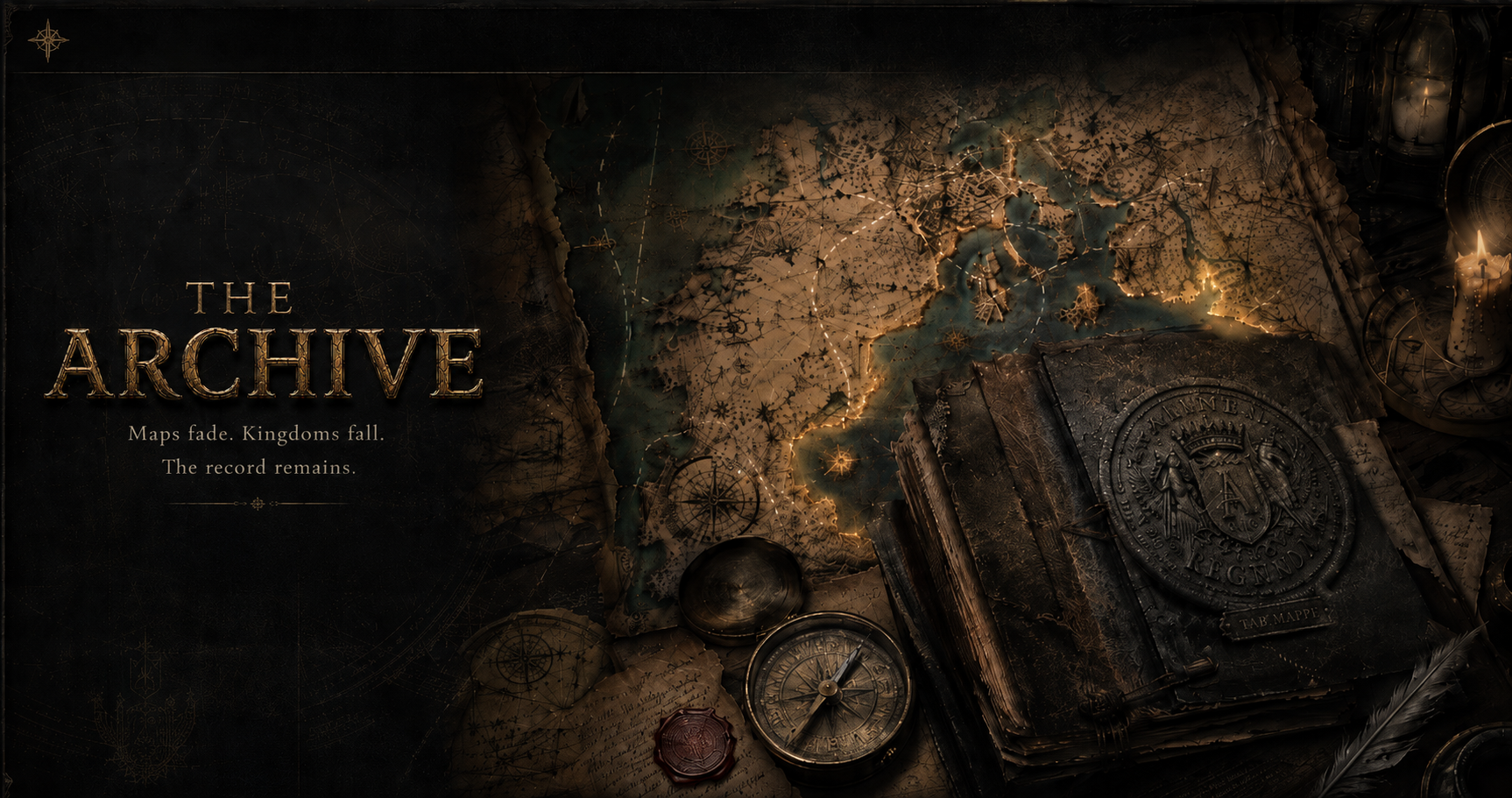
That is also why maps became central to the Archive.
A map is never the world itself.
It is evidence of what people believed the world to be.
Ancient maps were filled with errors, sea monsters, invented kingdoms, missing coastlines, political lies, and spiritual assumptions. But that is precisely why they fascinate me. They reveal how people understood existence itself. Every map is part geography, part fear, part ambition, and part imagination.
To me, ancientness is not dust.
It is continuity.
A long and tangled chain of human attempts to explain fear, nature, death, memory, and each other.
In Finland, this continuity carries a particularly strange tension through Kalevalaic tradition. Many people recognize Kalevala as culturally important, yet experience it as distant or difficult. Something preserved behind museum glass. Others romanticize Norse mythology while overlooking how closely many northern traditions mirror and overlap one another beneath the surface.
Growing up in South Karelia, I never experienced Kalevalaic language as entirely foreign. Its rhythm felt strangely natural to me. Later I realized many others encountered it differently, almost like an inherited memory they had been taught to keep at arm’s length.
That tension interests me deeply.
Not because I believe ancient cultures were purer, wiser, or morally superior. Every era carries brutality alongside beauty. Every civilization imagines itself modern. Every generation rewrites the past to justify something in the present.
Ancient worlds are rarely ancient at all.
They are mirrors.
Some people look into the past searching for comfort. Others search for authority, purity, or power. Some search for stories.
I have always searched for continuity.
And somewhere between forgotten coastlines, oral tradition, fractured myths, and unfinished maps, the SagaStory Archive slowly began to take shape.